International aid is defined as the assistance from rich and developed countries that is given to developing countries. The donors may be governments, non-governmental organizations, development banks, or various international organizations. The help they provide is channeled for a variety of reasons, be they moral, philanthropic, political, or economic. Aid is provided in multiple forms, from loans and grants to donations of agricultural equipment. In this article, we will look into whether they help developing countries or not.
Most transactions happen between developed and developing countries. The latter of them doesn’t have a good manufacturing base and has a low Human Develepment Index(HDI) — measure used to evaluate how developed a country is—not just economically, but in terms of people’s overall well-being.
Aid may be provided in these ways:
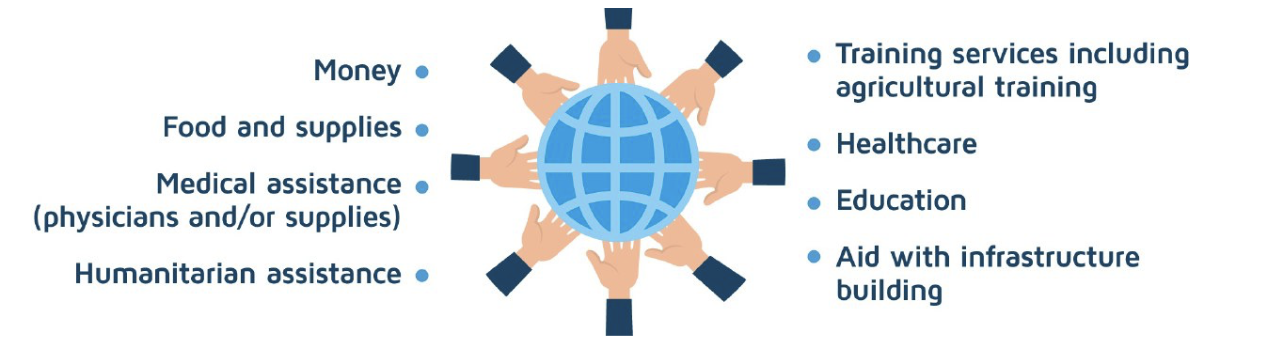
How it affects countries.
Aid can accidentally hurt local businesses. When a country receives a large amount of foreign money, its local currency can become too expensive compared to other nations. This is often called "Dutch Disease," and it makes it very difficult for local companies to sell products like clothes or crops to the rest of the world because their prices become too high for foreign buyers. If these export businesses cannot grow, it is much harder for a country to build a strong, independent economy.
Also, aid can change how a government treats its people. In most countries, governments rely heavily on tax revenue, which creates a system of accountability: citizens who finance public services demand responsiveness and effective governance in return. This is called Social contract. However, when a government receives a significant share of its revenue from foreign aid, leaders become less financially dependent on their own population, so the incentive to respond to citizens’ needs diminishes. As a result, governments may invest less in building strong institutions such as efficient tax systems, independent legal frameworks, and transparent public administration. Over time, this can slow institutional development, weaken democratic accountability, and allow political elites to delay or avoid necessary economic and governance reforms.
The case of Rwanda(Country in East Africa) shows both great success and future risks. Rwanda used aid to create a successful health insurance system that now covers 90% of its people. However, the country is still very dependent on donor money, which pays for nearly half of its healthcare costs per person. A major concern is that donors often prefer to fund "infectious" diseases like HIV while ignoring chronic "lifestyle" diseases like heart problems, leaving the poorest citizens to pay for those expensive treatments themselves.
China's aid strategy prioritizes trade capacity building over social grants. Instead of giving gifts, China uses export credits and commercial loans to provide nearly 90% of its foreign funding. According to the adage "to become rich, build the road first," this model gives priority to large-scale projects like energy and transportation. By highlighting these business-like partnerships, China provides alternative financing that aims to support countries' industrial and trade growth.
Small, well-tested projects are more successful than large cash transfers. According to recent experts, we should concentrate on testing particular small programs rather than attempting to determine whether "all aid" is effective. After conducting a thorough investigation, researchers discovered that minor adjustments—such as hiring local educators on temporary contracts—are far more effective at assisting kids in learning than just giving them more textbooks. This implies that a project's design is far more important than the total amount of funding allocated.
South Korea is a prime example of utilizing aid to attain complete independence. South Korea used foreign aid to stabilize its currency and make significant investments in its own people and factories following a major war. Importantly, instead of letting donors take the lead, the nation incorporated this assistance into its own long-term economic plans. After the United States threatened to stop providing aid, South Korea eventually stopped requiring it completely and became a dominant player in international trade.
Haiti(country in Caribbean) illustrates how aid fails when it bypasses local systems. Despite receiving billions of dollars, Haiti remains very poor because a large portion of aid is managed directly by outside groups and NGOs. When these groups handle the projects, the local government never develops the strength or skill to manage its own country.Instead of developing a self-sustaining economy, this puts the country in a "humanitarian trap" where it is forced to rely on foreign assistance for basic necessities.
Rather than just giving money, there are better ways to help. Aid is successful when it reaches "aid darlings"—nations that are already making significant efforts to strengthen their own legal frameworks and make effective use of their own resources. Accordingly, funding a research (such as developing new vaccines) or assisting developing countries in improving their access to international markets so they can sell their own products are often better than just providing funds to governments.
In conclusion, foreign aid's success depends heavily on local ownership, where the recipient government leads the strategy rather than simply following the rules of outside donors. As the global landscape shifts to new models of partnership and private investment, the ultimate goal remains for developing nations to build the strong local institutions needed to develop on their own.